The Diambulist Humself
2026
Metal, lightbulbs, neons, sensors, motors, dimmers, computers, microphones, speakers, amplifiers
264.5 × 214.5 × 188 cm
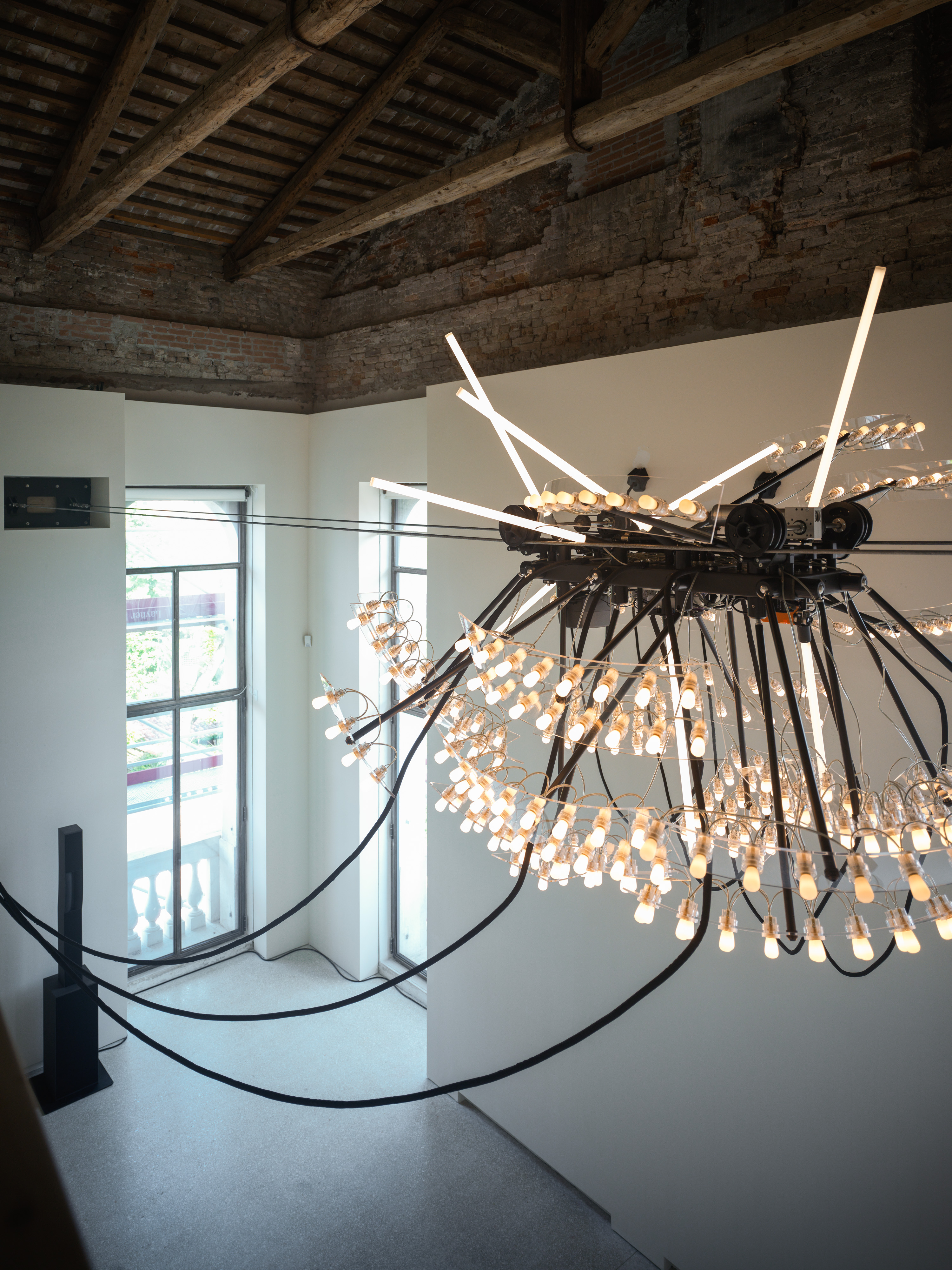
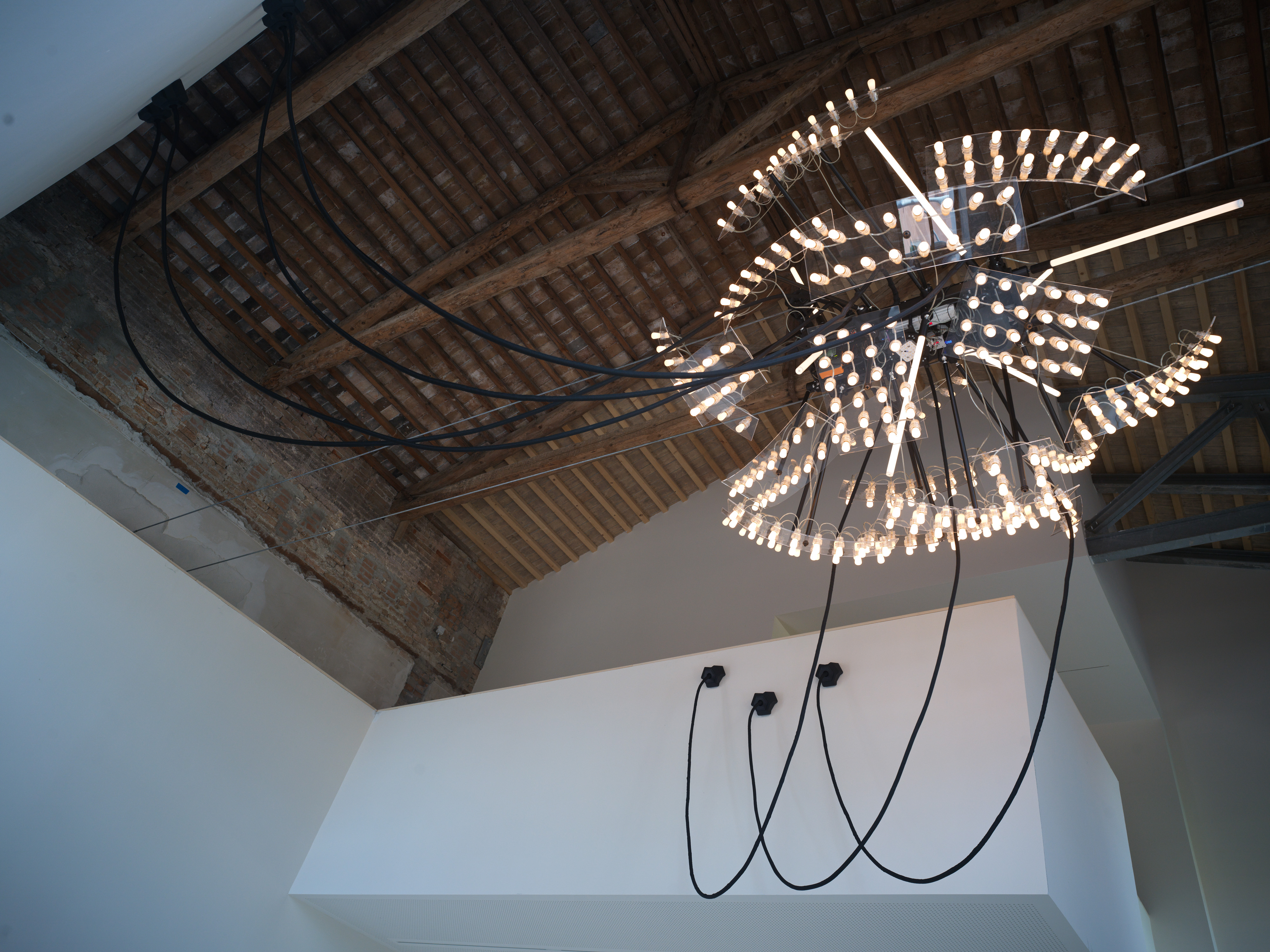
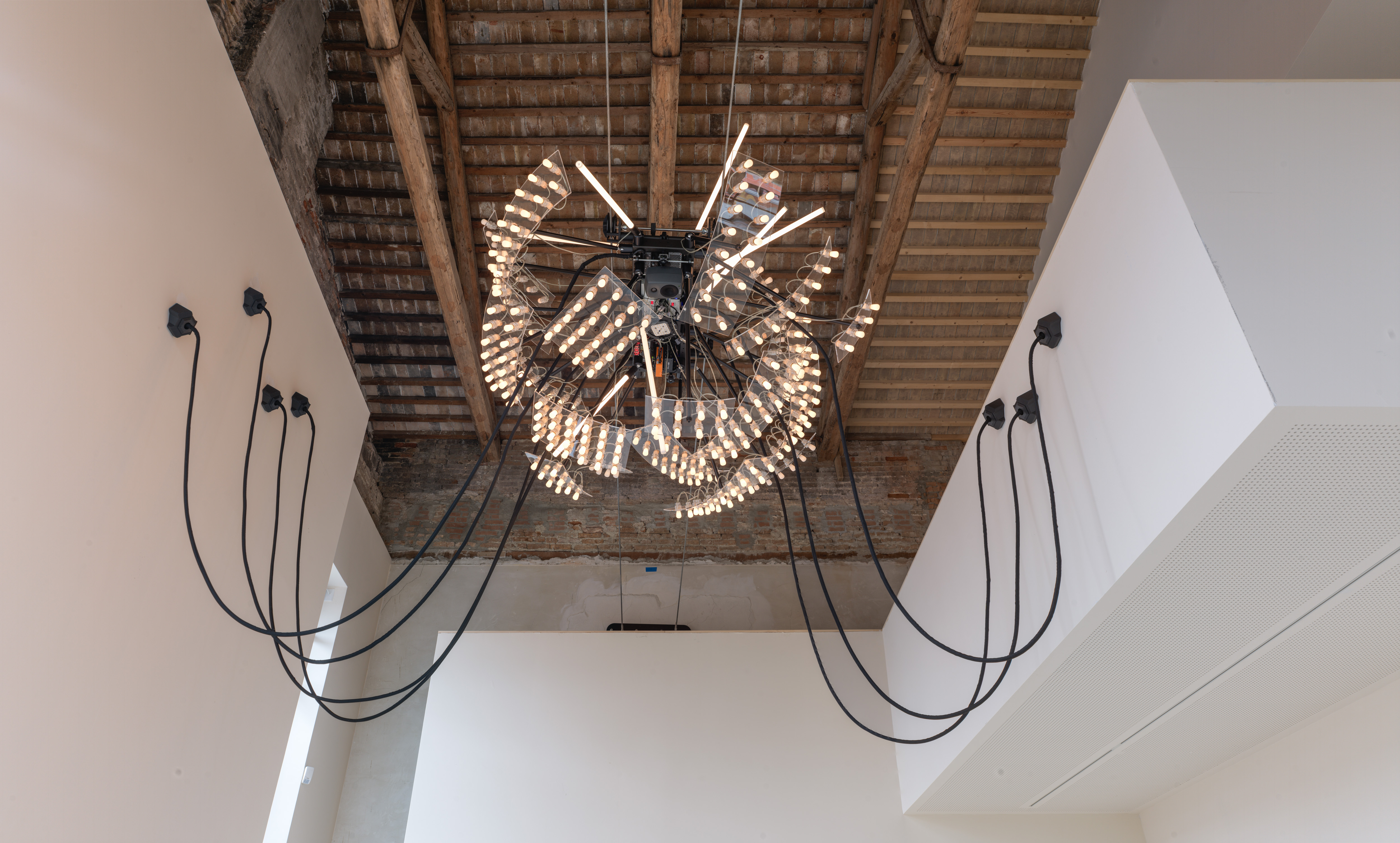
The Diambulist Humself extends Philippe Parreno’s ongoing inquiry into the exhibition as a living score—an orchestration of duration, attention, and contingency. Two electrified cables, stretched overhead like infrastructural arteries, convert the room into a field of tension: a suspended diagram of forces. Along this aerial axis, The Diambulist Humself circulates at shifting speeds, carrying an ensemble of dimmable LED lightbulbs and neons. The light is not simply an instrument of visibility; it is the work’s respiration, a moving climate that writes itself across the architecture.
Its motor and decision system are fed by a network of sensors that listen to both the immediate interior and the broader urban environment, allowing behavior to emerge from a conversation with the site rather than an illustration of it. Here, «local fiction» becomes an operative concept: fiction not as narrative content imported into a place, but as a latent mode of the real that condenses under specific circumstances and subtly rewrites the rules of perception.
Slow phenomena—tide cycles, atmospheric pressure, cloud cover, humidity, salt levels—operate as meta-signals, defining the work’s overall state and setting limits, ranges, and tempos over long arcs of time. The sculpture’s “mood” is therefore not metaphorical. It is computed, yet experienced as an ambient psychology unfolding over hours, with transitions so gradual they are felt only in retrospect.
In Venice, atmospheric pressure becomes entangled with the city’s vulnerability to water. The sculpture composes a form of anticipation without plot: a narrative of thresholds. Over this slow score, immediate signals such as footsteps, cable tension, fluctuating light, and the vibration of passing boats introduce micro-variations—small corrections, hesitations, accelerations, and near-pauses.
The Diambulist Humself’s intelligence is not representational but attentional. It does not interpret the environment as meaning; it negotiates it as condition. And it is precisely this negotiation—visible yet illegible, purposeful yet purposeless—that produces the work’s uncanny effect: the feeling that one is in the company of something perpetually adjusting its relation to a world it cannot fully predict.