Waterfalls explores an emerging AI technology used by call centres. This AI is used to filter and modify voices in real time and to "clarify offshore agents" from India, Haiti, the Philippines, and Pakistan. The technology strips away the accents of call centre employees and overlays a "placeless voice” in the name of "improving customer satisfaction and sales metrics."
It has emerged out of frustrations in the global north, where consumers increasingly interact with workers in the global south after corporations outsourced communication networks to regions with cheaper labour. This technology seeks to bypass xenophonia (the irrational fear or dislike of people who sound different to you). Here, automation is not taking jobs away from humans, but removing and alienating them from their own voices.
From online samples demonstrating this tool, artist Lawrence Abu Hamdan and his colleagues at Earshot reverse-engineered the algorithm to uncover the original voices beneath the "clarification." Through sound and four sculptural works, Abu Hamdan makes this research tangible. An evolving computational sound composition moves between the original speaker's phonemes and phrases on the left speaker and their AI-"clarified" versions on the right.
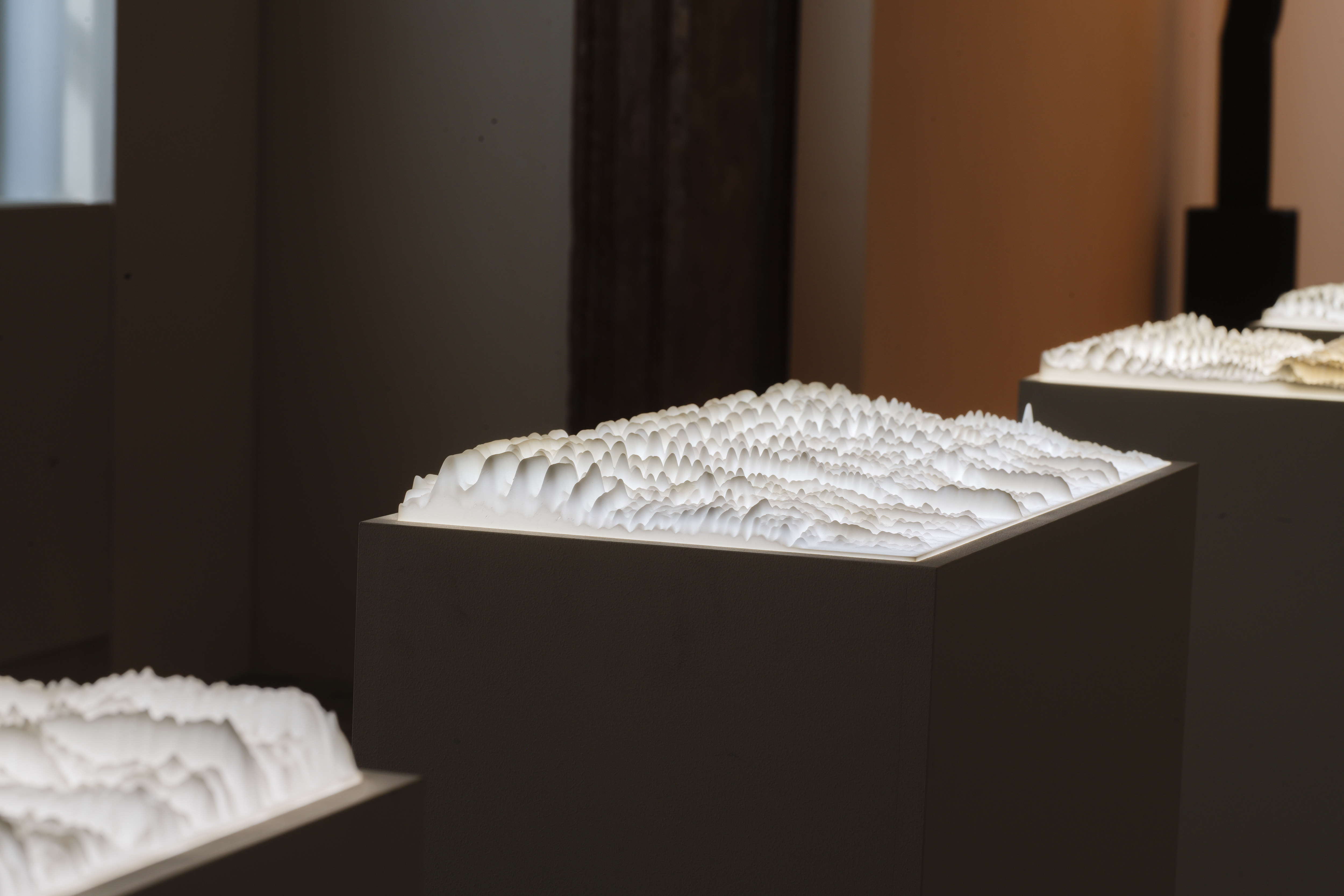
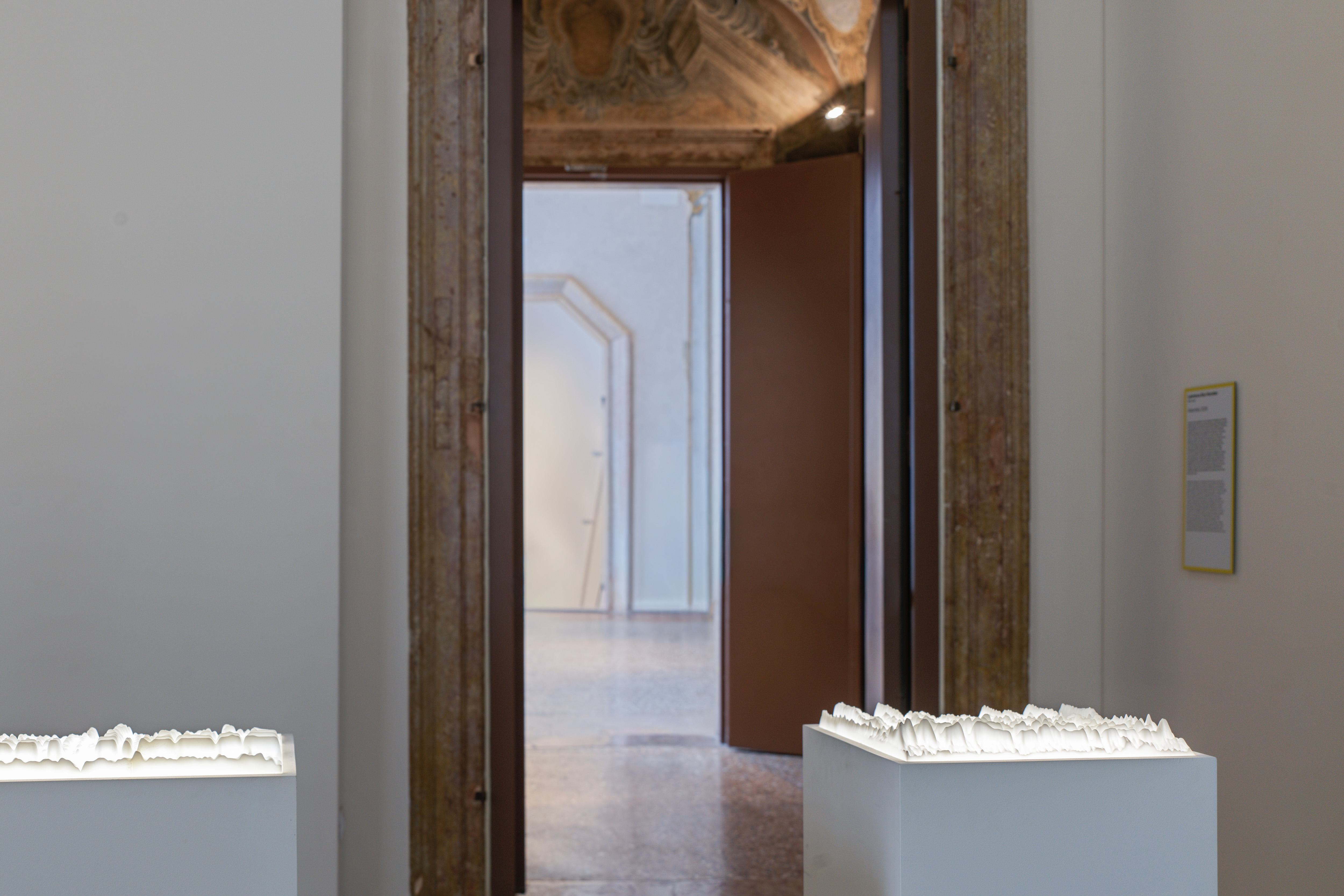
The four 3D-printed spectrographs each represent dialects from India, Haiti, the Philippines, and Pakistan respectively (left to right). These topographic forms visualise how sound behaves across the frequency spectrum, a visual technique called "waterfalls". This method transforms sound into topography, and in this work portrays accent as a physical place. The light underneath exposes how AI alters that terrain like a metamorphic process. Where you see the light passing through the resin, this is the original unedited voice of the call centre employee, leaving the dark parts to reveal the synthetic and artificially generated speech signal.
While the technology markets itself as "accent softening"—smoothing the audible friction of globalised trade networks—Abu Hamdan’s work challenges this framing. By visualising how AI amplifies consonants into sharp peaks and slices through vowels, cutting their natural undulation, this work seeks to expose rather than obfuscate the global supply chain behind each voice.
Photo by Joan Porcel Studio
Palazzo Diedo Berggruen Arts & Culture
Contacts This email address is being protected from spambots. You need JavaScript enabled to view it.